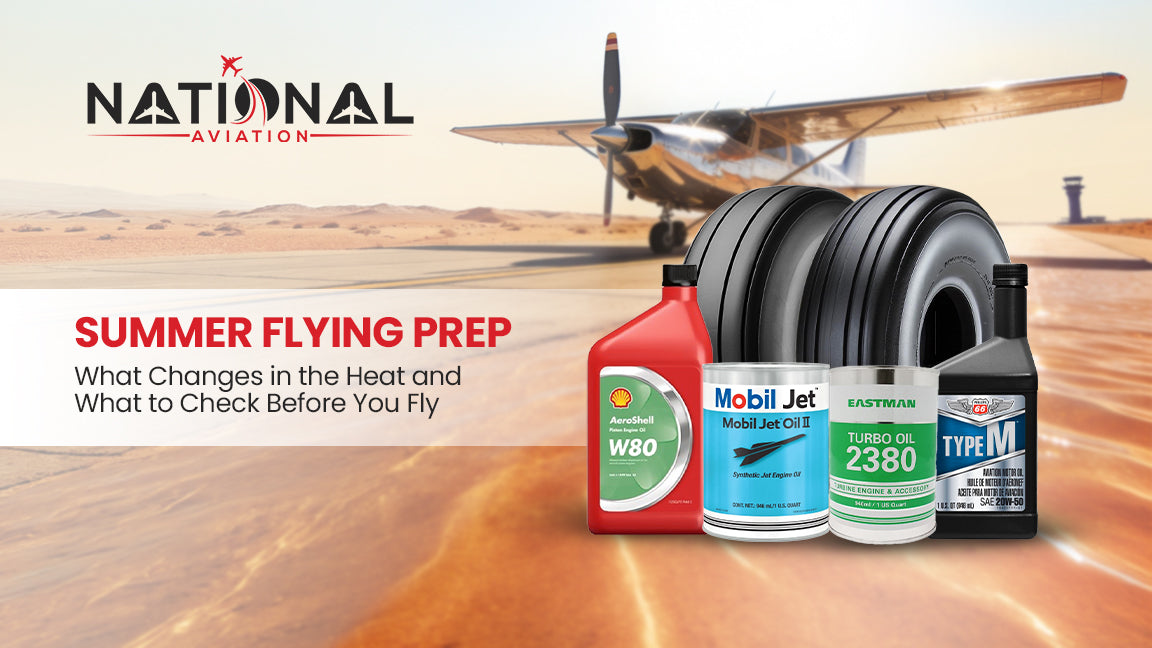
Summer changes four things you already check on every flight: engine oil behavior, tire pressure, density altitude, and the humidity that quietly makes density altitude worse. Here is what shifts in each one, and what to do about it before you taxi.
Engine Oil: What Heat Changes Under the Cowling
Aircraft engine oil does three jobs at once. It lubricates moving parts, carries heat away from the cylinders and bearings, and suspends combustion byproducts so they can be filtered or drained out at the next change. Every one of those jobs gets harder as ambient and operating temperatures rise, which is why the grade of oil that worked fine in a cold hangar in January is not automatically the right choice for a July afternoon.
Why Viscosity Grade Matters More in Summer
Lycoming's Service Instruction 1014 lays out viscosity recommendations by ambient temperature at engine start. As a general rule, single-grade SAE 40 or SAE 50 oils are recommended for warm-weather operation, while lighter grades are reserved for cold starts. Multigrade oils such as 15W-50 are formulated to perform closer to a straight SAE 50 once warm, while still starting more easily on a cool morning, which is why many owners run a multigrade oil year-round rather than switching grades with the seasons.
Continental engines follow a similar logic but with different numbers. Several smaller Continental models call for an 80-grade oil in normal operation rather than the 100-grade many Lycoming owners are used to. The takeaway is the same regardless of engine make, check your specific engine manufacturer's current service instruction rather than assuming last year's oil grade still applies, and never substitute automotive oil for an aviation-rated product.
Watching the Oil Temperature Gauge
Most piston aircraft engines carry a maximum oil temperature limit in the neighborhood of 245 °F, though that number should always be verified against your own POH. Reaching that limit briefly during a hot-day climb is a different situation than cruising near it for an extended period. Oil that runs consistently hot ages faster and breaks down its additives sooner. That means a thinner protective film right when the engine is working hardest. If you notice oil temperatures creeping higher on hot days than they used to, it is worth a look at baffling, cooler airflow, and the oil itself before assuming the gauge is simply reflecting the weather.
Hot Starts and Vapor Lock
Fuel-injected engines are particularly prone to a warm-weather starting problem known as vapor lock. After shutdown, residual engine heat radiates upward into the fuel injector lines. With no airflow moving through the cowling to carry that heat away, fuel sitting in those lines can vaporize. A fuel pump is built to move liquid, not vapor, so the result is a hard start, rough initial firing, or no start at all, particularly on a quick turnaround.
The fix is procedural, not mechanical, in the great majority of cases. Follow your aircraft's published hot-start procedure rather than improvising, since techniques that work on one fuel injection system can flood another. Running the boost pump briefly to push liquid fuel back through the lines is the standard approach on many aircraft. Opening cowl flaps or oil access doors after shutdown, and pointing the aircraft into any available breeze, can reduce how much heat builds up in the first place.
|
What to do: Confirm the current recommended oil grade for your specific engine model before each summer, since guidance is issued by ambient starting temperature, not calendar date. Track oil temperature trends across the season. A gradual rise on similar days can point to baffling, cooling, or oil condition issues worth addressing early. Use the aircraft's published hot-start procedure, not a generic technique borrowed from another airplane. |
Tire Pressure: What Hot Pavement Does Before You Ever Move
Tire pressure is temperature-sensitive by nature. The air or nitrogen sealed inside a tire expands as it warms and contracts as it cools, and that relationship holds whether the heat comes from rolling friction, braking, or simply the ramp underneath the tire on a summer afternoon. An aircraft that sat overnight in a hangar will show a different cold pressure than the same aircraft parked on sun-baked asphalt since sunrise.
A commonly cited rule of thumb, drawn from business jet maintenance guidance, is that tire pressure changes by roughly one percent for every 5°F of temperature change from a 70-degree baseline. On a ramp that goes from 70 degrees at dawn to 100 or more by early afternoon, that is a meaningful shift, and it happens before the aircraft has taxied a single foot.
Always Check Cold
The standard across both general and business aviation maintenance guidance is the same: check tire pressure when the tire is cold, meaning it has not been rolled, braked, or sitting in direct sun for an extended period. A tire that has just taxied in, or that has baked on the ramp all afternoon, will read artificially high. Bleeding pressure from a hot tire down to what looks like a normal cold reading will leave that tire chronically underinflated once it actually cools, which is a well-documented cause of sidewall flexing, heat buildup, and premature tread separation.
The safest habit is a simple one: check pressure in the morning, before the first flight of the day, using a calibrated gauge rather than a visual glance at the tire's shape. High-pressure aircraft tires can look normal even when significantly underinflated, since the sidewall does not always bulge the way a car tire's does.
Direct Sun and Extended Ramp Time
Aircraft that sit outside for days at a time in direct summer sun are also more prone to sidewall cracking and ozone damage, since heat accelerates the rubber aging process independent of how many landings the tire has seen. Wheel covers, hangar storage when available, and water-based tire protectants all reduce this exposure. Petroleum-based tire dressings should be avoided, since they can accelerate rather than slow rubber degradation.
|
What to do: Check tire pressure cold, in the morning, with a calibrated gauge, rather than relying on a visual check or a reading taken after the aircraft has been sitting in the sun. Never bleed pressure from a hot tire. Let it cool to ambient temperature first, then adjust. Use wheel covers or hangar storage when the aircraft will sit outside for extended periods in direct sun. |
Density Altitude: The Air You Cannot See Changing
Density altitude is the factor most likely to catch a pilot off guard in summer, precisely because nothing about it is visible from the cockpit. It is formally defined as pressure altitude corrected for nonstandard temperature. In plain terms, it describes how thin the air actually is relative to a standard-day baseline, and thin air behaves like altitude even when the airport elevation itself has not changed.
Every performance number in your POH, takeoff distance, climb rate, service ceiling, was generated under standard atmospheric conditions: 59 °F and 29.92 inches of mercury at sea level. When the actual temperature is higher than standard for that pressure altitude, the airplane performs as though it were operating from a higher, thinner-air airport than the one it is actually sitting on.
How Much It Actually Costs You
The effect compounds quickly. FAA guidance illustrates a case where an airplane's normal 1,000-foot sea-level takeoff distance grows to 3,300 feet under a combination of high elevation and high temperature, a more than threefold increase, while climb rate over the same conditions drops by roughly three-quarters. A flatland airport at only 1,000 feet of elevation can still see density altitudes of 3,000 to 4,000 feet on a hot, humid afternoon, so this is not a hazard limited to mountain airports.
● Takeoff roll lengthens because the propeller and wings both have fewer air molecules to work with for the same speed.
● Climb rate drops, sometimes dramatically, since engine horsepower output falls along with air density.
● Landing distance increases as well, since the same reduction in air density affects deceleration on rollout.
Calculating It Before You Go
Density altitude can be approximated with a simple formula: pressure altitude in feet, plus 120 multiplied by the difference between the outside air temperature and the standard temperature for that pressure altitude, both in degrees Celsius. Most electronic flight bag apps and many onboard avionics suites calculate it automatically, but knowing the formula is worth keeping in your back pocket in case that equipment is unavailable.
Humidity adds a smaller but real penalty on top of temperature and altitude. It does not typically get its own line in most quick calculations, but on a hot, humid day it is common practice to add roughly ten percent to a computed takeoff distance as a margin.
What to Do About It
● Fly earlier or later in the day when temperatures, and therefore density altitude, are lower.
● Reduce weight where practical rather than filling every seat and every tank on a hot, high-density-altitude day.
● Lean the mixture for takeoff at density altitudes above roughly 5,000 feet in normally aspirated engines, per your POH guidance, since an overly rich mixture only compounds the power loss.
● Use your actual POH performance charts for the day's temperature and pressure altitude rather than assuming book numbers from a cooler day still apply.
● Confirm 80 percent of your expected takeoff speed by the runway's midpoint, or abort, as a simple in-the-moment check that performance is tracking your calculations.
A Simple Summer Preflight Routine
None of the three factors above require new equipment or a change in how you fly. They require checking familiar numbers at the right time and with the right expectations for the season.
● Verify your engine's current warm-weather oil grade recommendation and confirm the sump is filled with it, not with whatever was convenient at the last change.
● Check tire pressure cold, in the morning, with a calibrated gauge, before the ramp has had a chance to heat the tires.
● Calculate density altitude for your actual departure conditions and cross-check it against your POH performance charts rather than estimating from memory.
● Plan an earlier or later departure time on days when temperature, elevation, and aircraft weight are all working against you at once.
● After landing, note anything unusual, a harder-than-expected start, a tire that felt low, sluggish climb, so it can be addressed before the next hot-weather flight rather than after.
When inflation checks or inspection turn up a tire or tube that needs replacing before the season heats up, National Aviation stocks Michelin and Goodyear tires and Airstop tubes across a range of sizes, ready to ship.
|
Product |
Price |
Availability |
|
Part No: 021-327-0 | 17.5x6.25-6, 8-ply, Pilatus PC-12 (NLG) |
$495.00 |
In stock |
|
Part No: 184F10-2 | 18x4.4, 10-ply, DDT construction |
$800.00 |
In stock |
|
Michelin Airstop Tube 092-500-0 Part No: 092-500-0 | 6.00-6 / 17.5x6.25-6, TR-20 straight stem |
$195.00 |
In stock |
|
Michelin Airstop Tube 097-373-0 Part No: 097-373-0 | 7.50-10 inner tube |
$178.44 |
In stock |
Browse the full Michelin aircraft tire collection and Goodyear aviation tire collection at National Aviation, and see our companion guide - Essential Aircraft Tire and Landing Gear Maintenance Tips Every GA Pilot Should Know.
When it is time to select or switch to a warm-weather oil grade, National Aviation carries AeroShell's full piston-engine oil lineup along with CamGuard, ready to ship. Free shipping on orders over $350 and same-day shipping on in-stock items.
|
Product |
Price |
Availability |
|
Part No: 100WQT | Ashless dispersant, single grade |
$10.00 |
In stock |
|
Part No: W100PLUSQT | Single grade with anti-wear additive |
$10.75 |
In stock |
|
Part No: W80PLUSQT | SAE 40 single grade with anti-wear additive |
$11.50 |
In stock |
|
AeroShell Oil 15W-50 Multigrade Part No: 15W50QT | Semi-synthetic, all-season |
$11.50 |
In stock |
|
CamGuard Aviation Oil Additive Part No: CAMGUARDPT | Corrosion and anti-wear supplement |
$25.50 |
In stock |
Browse the full aircraft oil and lubricants collection at National Aviation.
National Aviation
Aviation Supplies, Pilot Supplies and Aircraft Parts