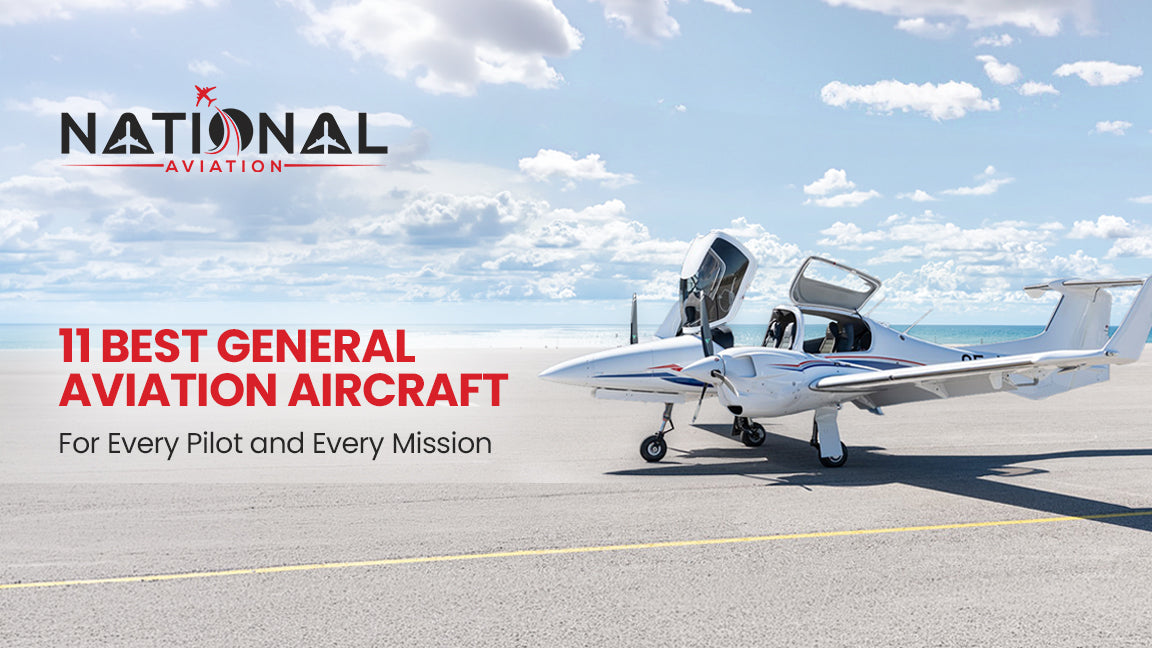
There is no single best general aviation aircraft, because there is no single mission. This list matches eleven aircraft to eleven of the missions that actually define the general aviation market, from primary training to personal jet ownership, each one the strongest fit for the pilot flying that mission today.
Specifications below reflect current manufacturer and market data as of 2026. Real-world performance always varies with weight, weather, and equipment, so treat these figures as a starting point for comparison, not a substitute for the POH.
1. Cessna 172 Skyhawk
Mission: First flight, primary training, and building time affordably
180 hp Lycoming IO-360 | 124 KTAS cruise | 640 nm range | 8 to 10 GPH
More than 44,000 have been built since 1956, which makes the Skyhawk the most-produced aircraft in aviation history and still the default trainer at flight schools worldwide. The current 172S pairs a fuel-injected 180 hp engine with Garmin G1000 NXi avionics, but the reason it endures has nothing to do with speed. Forgiving stall characteristics, a low 40-knot flaps-out stall speed, tricycle gear, and a parts and mechanic network that reaches nearly every airport in the country make it the safest default choice for a first airplane, whether that means a rental hour block or a first purchase.
2. Diamond DA40 NG
Mission: Efficient personal cross-country flying and modern flight training
168 hp Austro AE300 turbodiesel | 154 KTAS cruise | 675 to 900 nm range | 5 to 7 GPH on Jet-A
The DA40 NG trades the Skyhawk's simplicity for composite construction, a bubble canopy with excellent visibility, and a turbodiesel engine that burns Jet-A instead of increasingly contested 100LL avgas. Fuel burn as low as 5 gallons per hour, combined with a cruise speed nearly 30 knots faster than a 172, makes it the aircraft of choice for airline cadet academies worldwide and for private owners who want genuine cross-country capability without the fuel bill of a larger single. An Aviation Consumer analysis of NTSB accident records found the DA40's fatal accident rate at 0.35 per 100,000 flight hours, below the Cessna 172's 0.45 and well under the Cirrus SR20/SR22's combined 1.6, among the lowest in general aviation.
3. Cessna 182 Skylane
Mission: Family cross-country travel and light utility work
230 hp Lycoming/Continental | 145 KTAS cruise | 800 to 930 nm range | 13 to 14 GPH
Pilots who outgrow a 172's useful load usually land here next. The Skylane's roughly 1,100-pound useful load lets it carry four adults, bags, and full fuel without the weight-and-balance juggling that smaller singles require, and its high wing and sturdy gear tolerate rougher strips than most owners ever ask of it. The turbocharged T182T preserves climb and cruise performance at high-density-altitude airports where the normally aspirated model starts to struggle, making it the better choice for owners based near mountains or flying in summer heat.
4. Cirrus SR22T
Mission: High-performance personal travel with a built-in safety margin
315 hp turbocharged Continental TSIO-550 | 213 KTAS max cruise | 1,000+ nm range | 25,000 ft service ceiling
The SR22 series has been the best-selling piston aircraft in the world every year since 2003, and the turbocharged SR22T is the version built for pilots who fly over mountains, out of high-elevation airports, or simply want to climb above weather. Every SR22 carries the Cirrus Airframe Parachute System, a whole-airframe ballistic parachute that has been credited with more than 100 saved lives across the SR series and Vision Jet combined. The latest G7 generation adds Safe Return autoland, letting a passenger bring the aircraft down safely if the pilot becomes incapacitated.
5. Beechcraft Bonanza G36
Mission: Classic high-speed retractable-gear travel
300 hp Continental IO-550 | 176 KTAS cruise | 920 nm range | Six-seat cabin
The Bonanza line has been in continuous production longer than any other aircraft in history, dating back to 1947. The current G36 pairs that six-decade pedigree with a Garmin G1000 NXi flight deck and GFC 700 autopilot, delivering nearly 12 nautical miles per gallon at cruise, noticeably better fuel efficiency than a Cessna 182 covering the same distance. Club seating for six, a wide cabin, and retractable gear that trims drag without sacrificing the docile handling the Bonanza is known for make it the natural step up for pilots who have outgrown a fixed-gear single.
6. CubCrafters Carbon Cub UL
Mission: Backcountry exploration and short-field flying
160 hp turbocharged Rotax 916iS | 2,100 fpm climb | 50-ft takeoff roll | 90-ft landing roll
Built from the same basic recipe as the Piper Super Cub but roughly 300 pounds lighter thanks to modern composites and chromoly steel, the Carbon Cub UL can be off the ground in as little as 50 feet and stopped again in 90, numbers that open up gravel bars, ridge-top strips, and backcountry airfields that no other aircraft on this list can touch. Its turbocharged, multi-fuel Rotax engine runs on either avgas or unleaded mogas and is engineered to hold its performance at altitude, a factor that mattered enough for CubCrafters to set an unofficial Cub-type altitude record of 37,609 feet in late 2025.
7. Cessna Turbo Stationair HD (T206H)
Mission: Heavy-duty utility hauling, floats, and skydiving operations
310 hp turbocharged Lycoming TIO-540 | 161 KTAS cruise | 700 nm range | 1,441 lb useful load
Nicknamed the SUV of the skies, the Stationair is the largest piston single Cessna still builds, and its 44-inch double clamshell cargo doors are the reason it shows up in aerial photography, skydiving, and remote cargo operations that no ordinary four-seater could handle. A useful load north of 1,400 pounds means it can carry six occupants or a genuinely heavy mixed load of people and gear, and factory float certification makes it a common choice for operators serving lake and coastal communities without paved runways.
8. Diamond DA62
Mission: Twin-engine redundancy without twin-engine fuel bills
Two 180 hp Austro AE330 turbodiesels | 185 to 192 KTAS cruise | 1,280 nm range | 11 to 12 GPH total
Traditional piston twins like the Baron or Seneca deliver engine-out redundancy at the cost of doubled fuel burn and complex mixture, prop, and boost pump management on each side. The DA62 answers both problems with FADEC-controlled diesel engines that use single-lever power control on each side and burn roughly half what a comparable avgas twin does, around 11 to 12 gallons per hour total at cruise. Seven seats, twin gull-wing doors plus a large rear hatch, and a useful load over 1,500 pounds make it as much a family hauler as a redundancy play, one reason it has found buyers ranging from private owners to European government fleets.
9. Daher TBM 960
Mission: Business-speed personal travel in a pressurized single-pilot turboprop
Pratt & Whitney PT6E-66XT, 850 shp | 330 KTAS max cruise | 1,730 nm range | 31,000 ft ceiling
The fastest single-engine turboprop in production, the TBM 960 cruises at speeds that outrun some light jets while still landing on runways a jet could never use. Its digitally controlled PT6E-66XT engine and five-blade Hartzell Raptor propeller are managed through a single power lever, and the HomeSafe emergency autoland system can bring the aircraft to a full stop on a runway if the pilot becomes unresponsive. For an owner-pilot doing regular 500-plus nautical mile business trips, the TBM's recommended cruise of 308 KTAS on about 57 gallons an hour covers that distance in under two hours, without the type rating, crew, or fuel bill a light jet at similar speed requires.
10. Daher Kodiak 100
Mission: Do-everything utility turboprop work in remote and unimproved locations
Pratt & Whitney PT6A-34, 750 shp | 183 KTAS cruise | 900 to 1,130 nm range | Sub-1,000 ft takeoff roll
Designed originally for missionary and humanitarian flying into the remotest parts of the world, the Kodiak was built to replace aging Cessna 185s, 206s, and de Havilland Beavers that had become difficult to maintain and expensive to fuel with avgas. Its PT6 turboprop trades some piston-engine economy for turbine reliability and a useful load that a piston single simply cannot match, while a 54-by-57-inch cargo door and factory float-ready airframe let it move seamlessly between passenger, cargo, and floatplane configurations. It remains a favorite of bush operators, skydiving companies, and humanitarian aid organizations for exactly the reasons it was designed.
11. Cirrus Vision Jet G2+ (SF50)
Mission: The most attainable entry point into personal jet ownership
Williams FJ33-5A turbofan | 311 KTAS max cruise | 1,275 nm range | 31,000 ft ceiling
Since its 2016 certification as the first single-engine civilian jet, the Vision Jet has become the most-delivered business jet in the world every year since 2018, largely by opening jet ownership to pilots stepping up from a high-performance single rather than requiring a type rating and crew. It carries the same CAPS whole-airframe parachute as the SR-series, adds a Garmin Safe Return autoland system, and requires no multi-engine or jet type rating to fly. For an owner-pilot who has maxed out what a turboprop can do and wants genuine jet speed and altitude, it is the only jet on the market that does not also require a type rating or a professional crew to fly it.
Quick Comparison
A side-by-side look at where each aircraft sits on speed, range, and seating.
|
Aircraft |
Cruise |
Range |
Fuel Burn |
Seats |
|
Cessna 172 Skyhawk |
124 kt |
640 nm |
8-10 GPH |
4 |
|
Diamond DA40 NG |
154 kt |
675-900 nm |
5-7 GPH |
4 |
|
Cessna 182 Skylane |
145 kt |
800-930 nm |
13-14 GPH |
4 |
|
Cirrus SR22T |
213 kt |
1,000+ nm |
16-18 GPH |
4-5 |
|
Beechcraft Bonanza G36 |
176 kt |
920 nm |
14-15 GPH |
6 |
|
CubCrafters Carbon Cub UL |
~95 kt |
~390 nm |
9-10 GPH |
2 |
|
Cessna Turbo Stationair HD |
161 kt |
700 nm |
17-19 GPH |
6 |
|
Diamond DA62 |
185-192 kt |
1,280 nm |
11-12 GPH |
7 |
|
Daher TBM 960 |
330 kt |
1,730 nm |
~57 GPH |
5-6 |
|
Daher Kodiak 100 |
183 kt |
900-1,130 nm |
45-48 GPH |
9-10 |
|
Cirrus Vision Jet G2+ |
311 kt |
1,275 nm |
60-65 GPH |
5-6 |
Whatever You Fly, National Aviation Keeps It Flying
Eleven aircraft, eleven missions, and one thing every owner on this list has in common: none of them run on the airframe alone.
That is where National Aviation fits in. From Michelin and Goodyear tires and tubes to AeroShell and Phillips 66 engine oils, pilot gear, and everyday maintenance supplies, National Aviation stocks what every aircraft on this list needs between annuals, with free shipping on orders over $350 and same-day shipping on in-stock items.
National Aviation
Aviation Supplies, Pilot Supplies and Aircraft Parts