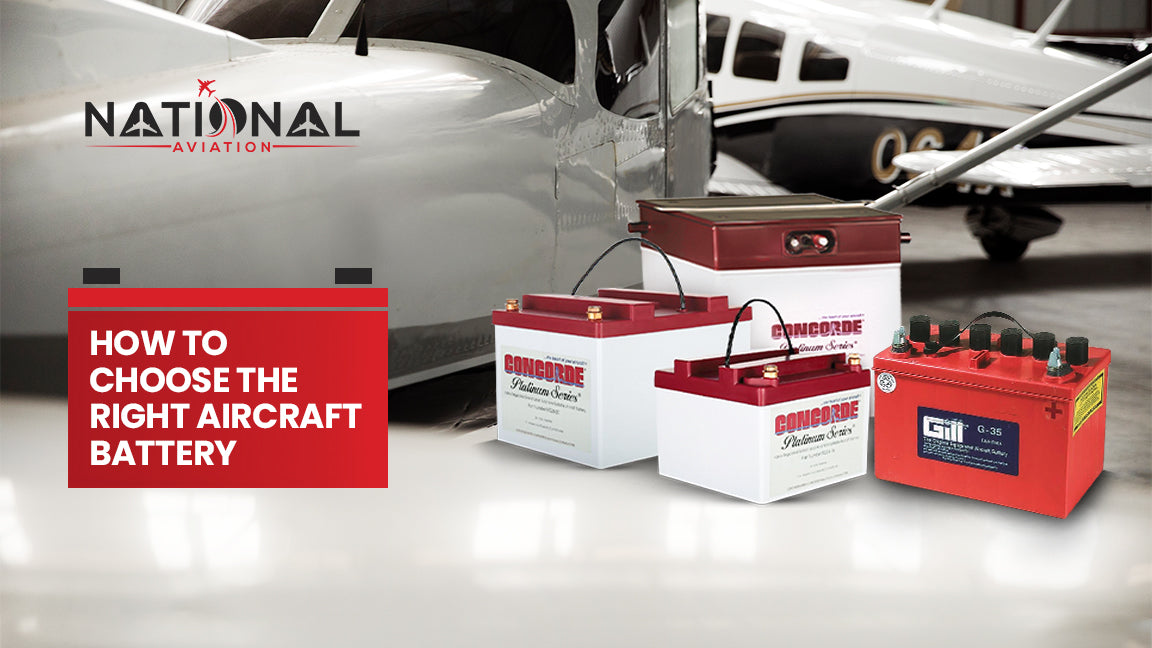
The battery gets ordered the same way the old one did: match the part number, check it fits, done. That approach works until it doesn't. The wrong chemistry for an aircraft's charging system shortens service life significantly. A capacity that seemed adequate turns out to be borderline when winter temperatures drop and the avionics load goes up. A battery sized for one airframe gets installed in a different one because the dimensions looked close enough, and the STC does not actually cover that model.
None of these are exotic problems. They show up regularly in GA maintenance because battery selection doesn't get the same structured attention as an engine overhaul or an avionics upgrade. This guide gives it that attention. It walks through chemistry, voltage, capacity, fitment, and temperature performance so you can make a decision based on your aircraft and how you actually fly, not just a part number match.
Why Battery Selection Is More Complex Than a Part Number Match
Aviation batteries are not automotive batteries with an aviation label. They are engineered for a specific set of stresses: high-current starting draws, sustained avionics loads, vibration, temperature extremes, and in many airframes, long periods of inactivity followed by demands for immediate full-power starts. An automotive battery will fail under these conditions faster and less predictably than a purpose-built aviation unit.
The variables that determine the right battery for a given aircraft interact with each other. A higher-capacity battery that runs cooler might tolerate undercharging from an aging alternator better than a lower-capacity unit, but only if it physically fits the tray and the chemistry is compatible with the charging voltage. Getting one variable right while ignoring another produces a result that is worse than useless.
|
The four questions that determine battery fit: ✓ What is the system voltage? (12V or 24V) ✓ What capacity (Ah) does the aircraft's electrical load require? ✓ Do the physical dimensions and terminal orientation fit the battery tray? ✓ Is there an applicable STC for this battery in this airframe? |
Step 1: Understand Battery Chemistry
Valve-Regulated Lead-Acid (VRLA) and AGM
The vast majority of piston-powered general aviation aircraft use sealed Valve-Regulated Lead-Acid (VRLA) batteries, most commonly in Absorbed Glass Mat (AGM) form. AGM batteries are maintenance-free, fully sealed, non-spillable, and compatible with virtually every aircraft charging system on the market. They are the safe, proven, universally accepted choice for Cessnas, Pipers, Beechcraft, and similar airframes.
Within the VRLA category there is meaningful variation. Entry-level AGM batteries use standard lead-calcium plates and are well suited to light aircraft with modest electrical loads. Platinum Series batteries use advanced plate alloys and glass mat separators that deliver higher cold-cranking amps, greater cycle depth, and longer calendar life. For aircraft with glass cockpits, autopilots, or high-draw strobes and landing lights, the Platinum designation is worth the premium.
Larger Cabin Aircraft and Turboprops
As aircraft grow in size, so do their electrical demands. Larger piston twins and turboprop aircraft typically require batteries with substantially higher capacity and, in many cases, a 24V electrical system. These batteries are physically larger, heavier, and built to deliver the high discharge rates required for turbine starts and sustained avionics loads. The form factor is also more varied: some large-cabin aircraft use batteries with specific hold-down provisions, connector types, or vent configurations that are not interchangeable across models even within the same voltage class.
Step 2: Match Voltage to Your Aircraft's Electrical System
Before anything else, confirm whether your aircraft runs a 12V or 24V electrical system. This is non-negotiable. Installing the wrong system voltage can cause immediate and serious damage to avionics, the alternator, and the battery itself. Your aircraft maintenance manual (AMM) or pilot's operating handbook (POH) will confirm this.
Most single-engine piston aircraft manufactured by Cessna, Piper, and other GA manufacturers use 12V systems. Most pressurized piston twins, turboprops, and jets use 24V systems. If you are unsure, ask your A&P.
Within a voltage class, battery voltage is not the only electrical consideration. The charging voltage produced by your alternator or generator must fall within the battery manufacturer's specified range. AGM batteries are sensitive to sustained overcharging: a regulator drifting high by even half a volt will accelerate water loss from the cells and shorten service life significantly. If the aircraft has a history of eating batteries prematurely, check the charging system before replacing the battery.
Step 3: Select the Right Capacity for Your Avionics Load
Battery capacity is measured in Amp-Hours (Ah). A higher Ah rating means more stored energy, which translates to longer endurance if the alternator or generator fails, and more robust starting power under high-load conditions. When sizing capacity, consider the total continuous electrical draw of all your avionics, lighting, and aircraft systems.
A common rule of thumb in general aviation: your battery should be able to power all essential avionics and complete a safe landing for at least 30 minutes without the alternator running. For IFR-equipped aircraft with glass cockpits, a larger-capacity battery is a wise investment. For a VFR trainer with minimal avionics, a smaller battery may be perfectly adequate and the weight savings are meaningful.
Capacity also interacts with how the aircraft is used. Aircraft that sit for weeks between flights draw the battery down through avionics standby loads and internal self-discharge. A battery at the lower end of the acceptable range for a given aircraft will reach its minimum charge state sooner than one with 20% more capacity. If your flying is irregular, sizing up slightly is cheap insurance.
Step 4: Verify Physical Fitment and STC Coverage
An aircraft battery must physically fit the battery tray or box in your airframe. Dimensions, terminal orientation, and hold-down requirements vary across aircraft makes and models. Never assume a battery will fit based on voltage and capacity alone. Cross-reference the manufacturer's physical dimensions against your aircraft maintenance manual or current battery specifications.
For certified aircraft, verify that the replacement battery is covered by the original Type Certificate (TC) or an applicable Supplemental Type Certificate (STC). STC coverage is not just a paperwork formality: it confirms that the battery chemistry, charging characteristics, and venting behavior have been evaluated for that specific airframe. Installing a battery without applicable STC coverage in a certified aircraft creates an airworthiness discrepancy. When in doubt, confirm with your A&P before the battery goes in.
Terminal orientation is one of the most commonly overlooked fitment details. Positive and negative posts on the wrong side of the battery can make correct cable routing impossible or force a cable length that creates resistance. Some battery trays also have specific vent tube connections that must align with the battery's vent port. Check the physical spec sheet, not just the voltage and capacity.
AGM vs. Flooded Lead-Acid: A Quick Comparison
If you are evaluating whether to stay with a standard flooded battery or move to a sealed AGM, this table covers the key differences:
|
Criteria |
Sealed AGM |
Flooded Lead-Acid |
|
Maintenance |
None (sealed) |
Electrolyte top-ups required |
|
Spillage risk |
None (non-spillable) |
Present if tipped or cracked |
|
Vibration tolerance |
Excellent |
Moderate |
|
Self-discharge rate |
Low |
Higher |
|
Cold crank amps |
High for size |
Variable by design |
|
Charging sensitivity |
Overcharge-sensitive |
More tolerant of variation |
|
Service life |
3 to 5+ years (typical) |
2 to 4 years (typical) |
|
Upfront cost |
Higher |
Lower |
Current Battery Sale at National Aviation
National Aviation is currently running a sale on 12 batteries with up to 25% off. The table below covers the complete lineup with pricing and availability. Every model links directly to the product page for full specifications.
|
Battery Model |
Was |
Sale Price |
Savings |
Stock |
|
Concorde |
|
$309.00 |
11% OFF |
In stock |
|
Concorde |
|
$799.00 |
11% OFF |
In stock |
|
National Aviation |
|
$2,999.00 |
25% OFF |
In stock |
|
National Aviation |
|
$2,399.00 |
8% OFF |
In stock |
|
National Aviation |
|
$4,499.00 |
21% OFF |
In stock |
|
Concorde |
|
$1,999.00 |
13% OFF |
Sold Out |
|
Concorde |
|
$3,999.00 |
20% OFF |
In stock |
|
Concorde |
|
$6,999.00 |
13% OFF |
In stock |
|
Concorde |
|
$2,999.00 |
19% OFF |
Only 1 left |
|
Concorde |
|
$2,499.00 |
24% OFF |
In stock |
|
Concorde |
|
$2,999.00 |
14% OFF |
In stock |
|
Concorde |
|
$3,999.00 |
20% OFF |
Sold Out |
Maintaining Your Aircraft Battery for Maximum Life
Even a correctly matched battery will underperform and fail prematurely without proper care. These practices apply to any sealed AGM battery in GA service:
✓ Use a smart AGM-compatible battery maintainer when the aircraft is hangared for more than a week. Prolonged discharge below 10.5V causes irreversible sulfation in lead-acid batteries.
✓ Have capacity tested annually by a qualified A&P or avionics shop. Resting voltage alone does not reveal true battery health.
✓ Inspect terminals for corrosion at every annual inspection. Even fully sealed AGM batteries can develop terminal oxidation in humid hangar environments.
✓ Follow a time-based replacement schedule. Most sealed AGM batteries in regular GA service should be replaced on a 3 to 5 year cycle, regardless of apparent condition.
✓ Keep a maintenance log. Recording installation date, charge cycles, and capacity test results helps your A&P track battery health and plan ahead for replacement.
|
Shop the Battery Sale at National Aviation Up to 25% off. 12 batteries in stock. Limited quantities on select models. |
Making the Decision
Work through the four questions in order: voltage first, then capacity, then physical fitment, then STC coverage. Any battery that passes all four is a legitimate candidate. From there, the choice comes down to Platinum Series versus standard for aircraft with heavier electrical loads, and whether the service interval aligns with how frequently you fly.
If you are replacing a battery that failed earlier than expected, find out why before ordering the replacement. Premature failure almost always traces back to one of three things: chronic undercharging from infrequent flying, chronic overcharging from a drifting voltage regulator, or a capacity mismatch that was undersized for the aircraft's actual electrical load. Addressing the root cause means the next battery lasts as long as it should.
|
National Aviation Aviation Supplies, Pilot Supplies and Aircraft Parts |