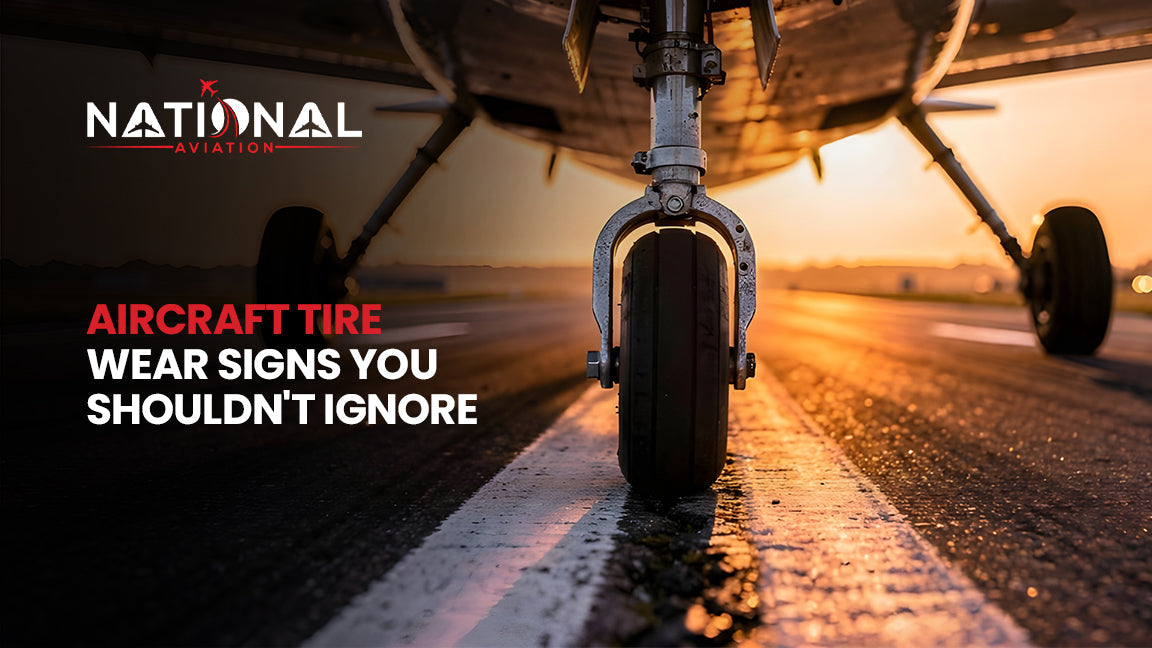
Aircraft tires do more continuous work than almost any other component on the airframe. Every landing loads them with the full weight of the aircraft at the instant of touchdown. Every takeoff roll asks them to accelerate from a standstill to rotation speed in a matter of seconds. Every taxi hour keeps them under static load, exposed to ozone, UV, and whatever the ramp surface has to offer.
Despite this workload, tire inspection tends to get the least attention on the walkaround. A quick glance at each wheel, a tap with a toe, and most pilots move on. The wear patterns sitting right there on the rubber go unread because nobody taught them what to look for. This guide fixes that. It walks through every tire wear pattern you need to know, explains the underlying cause for each one, and tells you exactly what to do before the next flight.
Throughout, we will reference quality replacement tires and tubes available at National Aviation. Both Michelin aircraft tires and Goodyear aviation tires are stocked and ready to ship, so when it is time to replace, you will know exactly where to go.
Why Aircraft Tires Wear Differently Than Car Tires
Most pilots have years of experience reading car tire wear. Aircraft tire wear follows some of the same principles, but the operating environment introduces variables that have no equivalent on the road.
|
Key differences that affect aircraft tire wear: • Aircraft tires go from zero to rotation speed in seconds, generating intense frictional heat at the point of contact. • On touchdown, the tire is momentarily stationary before spin-up, causing a flat spot of rubber to be stripped away with every landing. • Aircraft sit on the same contact patch for extended hangar time, causing localized flat-spotting and ozone cracking. • Hard braking on rollout concentrates wear in a narrow band on the main gear tires. • Nose wheel shimmy, misaligned gear, and improper inflation all produce wear patterns that tell a specific mechanical story if you know how to read them. |
Seven Tire Wear Patterns and What They Mean
1. Center Tread Wear (Overinflation)
When the contact patch is too narrow because the tire is carrying too much pressure, only the center rib wears. The shoulders remain relatively intact while the crown erodes rapidly. This is the most common wear pattern in general aviation and is almost always caused by overinflation.
Overinflation also reduces the tire's ability to absorb landing shock, transferring that load into the wheel assembly, struts, and airframe. Over time it accelerates bearing wear and can cause fatigue cracks in the wheel.
|
What to do: Check inflation against the aircraft's maintenance manual or tire placard before every flight. Tires should be inflated cold. Never bleed hot tires down to a cold pressure reading. |
2. Shoulder Wear (Underinflation)
The inverse of center wear, shoulder wear occurs when the tire is underinflated and the contact patch spreads too wide. The tread shoulders carry the load while the center barely touches the pavement. The tire runs hot, the casing flexes excessively, and internal heat buildup accelerates casing fatigue and can lead to tread separation or sudden deflation.
Underinflated tires also increase rolling resistance, can cause a tire to slip on its wheel rim during braking, and create a dangerous handling characteristic during crosswind landings.
|
What to do: Inspect tire sidewalls for bulging or wrinkling as well as shoulder wear. Either indicates chronically low pressure. If the inner tube has been pinched due to running flat, the tube should be replaced along with the tire. |
|
Replacing inner tubes at National Aviation: When a tire is removed for inspection or replacement, the inner tube should be replaced at the same time. National Aviation carries a full range of Michelin Airstop tubes, recognized as the benchmark for aircraft inner tube reliability: |
|
Part No: 092-500-0 | 6.00-6 / 17.5x6.25-6 inner tube |
$195.00 In stock |
|
Michelin Airstop Tube 092-318-0 Part No: 092-318-0 | Inner tube, general aviation |
$186.00 In stock |
|
Part No: 097-500-0 | Air X series inner tube |
$154.95 In stock |
|
Michelin Airstop Tube 097-373-0 Part No: 097-373-0 | Airstop inner tube |
$178.44 In stock |
Browse the full Michelin aircraft tire collection at National Aviation.
3. Flat Spot Wear
A flat spot is a localized area of accelerated wear caused by the tire sliding rather than rolling. In aircraft, flat spots appear in two distinct situations: touchdown spin-up (the tire is not spinning when it contacts the runway, so it scrubs rubber before accelerating to ground speed) and locked-wheel braking (the wheel stops turning while the aircraft is still moving).
Minor flat spots from normal touchdown spin-up are expected and appear as a smooth, slightly worn patch on one side of the tread. Severe flat spots from brake lockup appear as deep, squared-off cuts through the tread, sometimes exposing the casing cords. A tire with exposed cord fabric must be removed from service immediately.
|
What to do: Inspect the entire circumference of each tire, not just the most visible section. Rotate the tire by hand during preflight if possible. A single deep flat spot is grounds for replacement before the next flight. |
4. One-Sided (Camber) Wear
When one side of the tread wears significantly more than the other, the cause is almost always a wheel alignment or landing gear geometry problem. Bent axles, worn shimmy dampers, improperly adjusted bungees or springs, and strut misalignment all cause camber-type wear. This pattern is especially common on nose wheels and tailwheels that experience shimmy loads.
One-sided wear is a symptom, not a root cause. Simply replacing the tire without addressing the underlying alignment issue means the new tire will wear in exactly the same pattern.
|
What to do: Have an A&P inspect the landing gear geometry before fitting a replacement tire. Check the nose gear shimmy damper for wear and proper fluid level. Check main gear attachment points and axle alignment. |
5. Cupping or Scalloping
Cupped wear appears as a series of rounded scoops or scallops around the circumference of the tire, creating a wavy contact surface rather than a smooth one. It is caused by dynamic imbalance in the wheel and tire assembly, by worn wheel bearings that allow the wheel to bounce slightly as it rolls, or by shock absorber deterioration that allows suspension oscillation.
Cupping creates vibration feedback through the airframe during taxi and rollout. If you feel a rhythmic shimmy or buzzing through the rudder pedals that does not correspond to runway surface texture, cupped tires are a prime suspect.
|
What to do: Have the wheel assembly balanced after fitting new tires. Inspect wheel bearings for roughness or excessive play. Have the shimmy damper and shock strut serviced if bouncing or vibration persists after tire replacement. |
|
Goodyear aviation tires at National Aviation: Goodyear's Flight Custom III and Three-Rib series are among the most widely used tires in general aviation, trusted for consistent tread wear life and predictable braking performance. Available now at National Aviation: |
|
Goodyear Flight Custom III 600x6 8-Ply Part No: 606C86-6 | 600x6, 8-ply, TT/TL |
$419.95 In stock |
|
Part No: 156E66B1 | 6.00-6, 6-ply rib |
$235.00 In stock |
|
Goodyear Flight Custom III 156E66-4 Part No: 156E66-4 | 6-ply, tubeless option |
$340.00 In stock |
View the complete Goodyear aviation tire collection at National Aviation.
6. Sidewall Cracking and Ozone Damage
Fine surface cracks running perpendicular to the direction of rotation on the sidewall, or small checks in the tread grooves, are signs of ozone degradation or age hardening. These are not friction wear patterns but are equally dangerous. Ozone breaks down the rubber's elasticity, making the casing brittle and prone to sudden failure under the flexing loads of taxi and landing.
Tires stored in sunlight, near electric motors (which emit ozone), or simply aged beyond their calendar service life are susceptible. Many aircraft sitting in hangars or on tie-downs develop sidewall cracking even with very few landings on the tire.
|
What to do: Follow the manufacturer's calendar replacement recommendations, not just tread depth. A tire that looks fine on the tread surface may still need replacement based on age or visible sidewall checking. Depth of cracks matters: surface checking is a caution; deep cracks reaching the casing fabric are an immediate removal from service. |
7. Tread Depth: When the Numbers Tell You to Stop
Most aviation tire manufacturers mark a tread wear indicator (TWI) in the tread grooves. When the tread surface wears flush with the bottom of the wear indicator slot, the tire has reached its minimum depth limit. Operating a tire beyond this point leaves no reserve rubber to manage braking loads, dissipate heat, or clear water from the contact patch.
For tires without a visible TWI, the FAA's general guidance is that tires should be replaced when tread depth reaches 1/32 inch or less, or when any cord fabric is visible, whichever comes first. There is no grace period for exposed cords.
|
What to do: Keep a small tread depth gauge in your flight bag. Check the tread depth on all three tires at every oil change or 50-hour inspection at minimum, and on the main gear tires more frequently if you fly from short fields or make frequent touch-and-goes. |
How to Inspect Aircraft Tires Properly
A thorough tire inspection takes less than three minutes and should follow the same sequence every time. Here is the method:
1. Visual tread scan: Crouch at wheel height and scan the full visible tread arc for flat spots, cuts, embedded objects, or unusual wear patterns.
2. Sidewall check: Examine both sidewalls for cracking, bulging, or chafing marks. Bulging is a critical finding and means the tire must not fly.
3. Valve stem check: Confirm the valve stem is not cracked, bent, or leaking. A valve stem failure in flight is a slow but dangerous event.
4. Pressure check: Use a calibrated aviation tire gauge, not a car gauge. Cross-reference the reading against the maintenance manual. Check cold, before the first flight of the day.
5. Rotation check: If the aircraft is on jacks or you can hand-spin the nosewheel, rotate each tire and look for flat spots on the bottom as the full circumference comes into view.
6. FOD inspection: Run your finger carefully around the tread grooves looking for embedded gravel, wire, or debris. A small stone caught in a groove will eventually work through the casing.
|
Preflight tip: Always inspect the tire after landing too, not just before the next flight. A cut or flat spot from a rough runway departure is much easier to deal with at your destination than on the morning of an IFR departure. |
When to Replace, Not Just Monitor
Some findings call for continued monitoring. Others call for immediate replacement. Here is how to draw the line:
|
Replace immediately if you find any of the following: • Any visible cord fabric or breaker ply, regardless of location • A sidewall bulge of any size • A cut or gash that penetrates into the casing body • A flat spot that exposes cord fabric at any point in its arc • Tread worn flush with the tread wear indicator • Any tire that has taken a known blowout, hard flat, or runway debris impact event |
|
Monitor and re-inspect at next service if you find: ✓ Fine surface ozone checking without depth (monitor calendar age) ✓ Minor flat spot with no cord exposure and more than 50% tread remaining ✓ Center or shoulder wear that has not reached the TWI ✓ Tread depth at 50% of original depth (begin sourcing replacement) |
Shop Replacement Tires and Tubes at National Aviation
When inspection tells you it is time to replace, National Aviation has you covered with a full inventory of certified aircraft tires and inner tubes from the industry's two most trusted brands. Free shipping on orders over $350 and same-day shipping on in-stock items.
Michelin Aircraft Tires and Tubes
Michelin's Air X radial tire series and Airstop inner tubes set the standard for GA aircraft. The Air X's radial casing runs cooler than bias-ply alternatives, extends tread life, and improves fuel efficiency through lower rolling resistance. Airstop tubes use a proprietary butyl compound that resists air permeation, maintaining pressure longer than standard tubes.
Browse all Michelin aircraft tires and tubes at National Aviation
Goodyear Aviation Tires and Tubes
Goodyear's aviation tire range spans light trainers to high-performance singles and light twins. The Flight Custom III remains one of the most widely fitted tires in general aviation, known for consistent tread wear and predictable ground handling. The Flight Eagle radial series brings modern radial technology to aircraft that benefit from reduced operating temperatures and longer service intervals.
Browse all Goodyear aviation tires at National Aviation
Five Habits That Extend Tire Life
Replacement tires cost money. These habits cost nothing and can double the service life of a set of tires:
7. Land on centerline: Drifting main gear off centerline causes one tire to scrub sideways on touchdown. Over many landings, this builds asymmetric wear rapidly. Precise centerline landings distribute spin-up wear evenly.
8. Avoid hard braking: Brake smoothly to a stop rather than using abrupt, heavy brake inputs. If the aircraft is equipped with anti-skid, ensure the system is functioning correctly. A single locked-wheel event can remove 20 to 30 percent of tread life from the affected tire.
9. Check pressure cold: Tire pressure rises significantly as the tire heats up during taxi and flight. Always measure cold pressure, before the first movement of the day. Bleeding pressure from a hot tire results in chronically underinflated operation once the tire cools.
10. Rotate tires when possible: On aircraft where rotation is permitted by the maintenance manual, swapping the left and right main gear tires at major inspections evens out the wear caused by consistent crosswind operations or runway crown camber.
11. Protect tires from UV and ozone: Use wheel covers or hangar your aircraft when possible. Tire dressings that contain petroleum distillates accelerate rubber degradation. Use only water-based tire protectants if you choose to use any at all.
What the Regulations Say
FAR 91.409 governs annual inspections, within which tires are a required inspection item. AC 43.13-1B, Chapter 9, provides detailed guidance on acceptable tire condition criteria for certified aircraft. For experimental aircraft, the condition inspection follows the manufacturer's guidance or, absent that, accepted industry practices.
A tire with exposed cord fabric is not airworthy under any interpretation of the regulations. A tire with tread at or below the TWI should be documented in the maintenance log and replaced before the next flight, even if the aircraft is within its annual inspection interval. Your A&P can make the call on marginal findings; the definitive findings described above are not judgment calls.
|
Ready to Replace? Shop Aircraft Tires at National Aviation Free shipping on orders over $350 | Same-day shipping on in-stock items | FAA-approved parts |
Final Word: Tires Are Not a Set-and-Forget Item
Of all the preflight items on the walkaround checklist, tires are the ones most pilots rush through. A glance at the main gear from five feet away does not constitute a tire inspection. Three minutes, done the same way every time, is what it actually takes.
Know the seven wear patterns. Inspect consistently. Replace without hesitation when the findings require it. And when you are ready to order, National Aviation's inventory of Michelin and Goodyear aviation tires is stocked and ships fast. Use code NA10 for 10% off your order.
|
National Aviation Aviation Supplies, Pilot Supplies and Aircraft Parts |