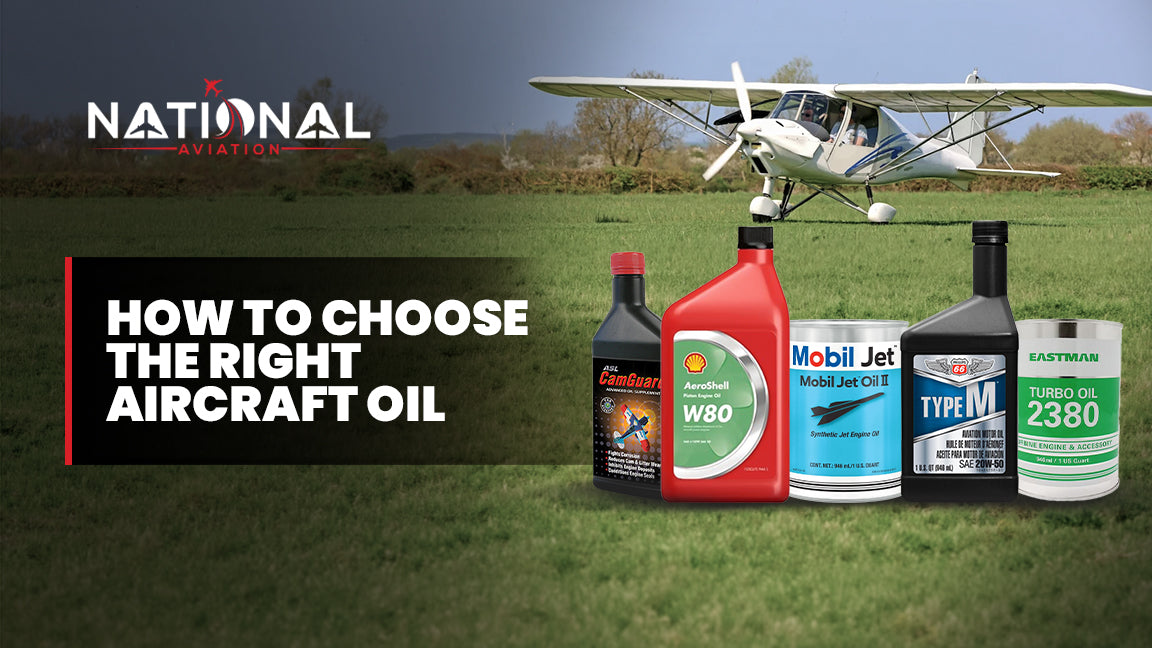
Your aircraft engine is the most expensive component on your airframe, and the oil circulating through it is the single most critical consumable you will ever buy. Yet with so many types, grades, and brands on the market, selecting the right aviation oil can feel overwhelming. Do you need ashless dispersant or mineral? Single-grade or multi-grade? A piston-engine oil or a turbine formulation?
This is a straightforward guide backed by real products from National Aviation to help you choose the right oil.
Why Aircraft Oil Is Different
Unlike automotive engine oil, aviation oil must perform under extreme temperature swings, from a cold hangar start at -20° F to operating temperatures that can exceed 240° F, at altitudes where atmospheric pressure drops significantly. It must resist oxidation, prevent corrosion from moisture and combustion acids, suspend lead by-products from avgas, and maintain stable viscosity from the first second of engine start.
Aviation oils generally fall into three main categories: mineral, ashless dispersant (AD), and synthetic. Mineral oils are typically used during the engine break-in period, while AD oils include additives that prevent sludge and deposit buildup during regular operation. For turbine engines, synthetic oils are the standard.
The 3 Main Types of Aviation Oil
1. Straight Mineral Oil: For Engine Break-In
Straight mineral oil is the traditional choice for new, rebuilt, or recently overhauled piston engines. Because it is less slippery than modern formulations, it allows piston rings to properly seat against cylinder walls during the critical first 25 to 50 flight hours. Once break-in is complete, you must transition to an ashless dispersant oil.
The Phillips 66 Type M (20W-50) is the most widely recognized mineral oil in general aviation and carries a Type M designation precisely for this purpose.
|
Phillips 66® |
$10.50 |
2. Ashless Dispersant (AD) Oil: For Normal Operation
Once your engine is broken in, ashless dispersant oil becomes the standard for ongoing operation. AD oils contain carefully engineered additives that keep combustion by-products, including carbon particles and lead deposits from avgas, suspended in the oil until it is drained. This prevents sludge and deposit buildup that can clog oil passages and cause hot spots in cylinder walls.
The term "ashless" distinguishes these from old-style detergent oils: AD oils leave no metallic ash residue that could damage engine components. Lycoming's official guidance recommends that most of its engines transition to AD oil after break-in is complete, noting that all turbocharged Lycoming models should use AD oil from the very first run.
AeroShell W100 Plus and AeroShell W80 Plus are among the most trusted AD oils in general aviation, engineered specifically for four-stroke piston aircraft engines.
|
AeroShell™ |
$10.75 |
|
AeroShell™ |
$11.50 |
|
Important: Do Not Mix Oil Types or Brands • Mixing different oil types is strongly discouraged except as a temporary emergency measure. • Different additive packages can react negatively, reducing lubrication effectiveness. • Always record the oil type and brand in your engine logbook at every oil change. |
3. Turbine Engine Oil: For Jet and Turboprop Aircraft
Turbine engines operate at far higher speeds and temperatures than piston engines, reaching up to 1,000 degrees C in some stages. They require specialized synthetic turbine oils engineered to withstand extreme thermal stress, prevent coking (carbon deposit buildup), and act as a heat transfer fluid to cool bearings and other critical components. Turbine oil is not interchangeable with piston engine oil.
|
ExxonMobil™ |
$27.00 |
|
Eastman™ |
$36.00 |
|
ExxonMobil™ |
$27.00 |
|
Eastman™ |
$46.53 |
|
ExxonMobil™ |
$25.00 |
Single-Grade vs. Multi-Grade: Which Is Right for You?
|
Type |
Best For |
Example Products |
|
Single-Grade (W80, W100) |
Warmer climates, stable temperatures, high-time engines |
AeroShell W80 Plus, AeroShell W100 Plus |
|
Multi-Grade (20W-50) |
Cold climates, year-round use, wider temperature range |
Phillips 66 Type M 20W-50, AeroShell 15W-50 |
|
Turbine / Synthetic |
Jet engines, turboprops, APUs |
Mobil Jet Oil II, Eastman 2380, Mobil 291 |
Multi-grade oils use a viscosity index improver, a long-chain molecule that maintains consistent flow characteristics whether the oil is cold or hot. This makes them ideal for aircraft operating in variable climates without switching between seasonal grades.
Oil Additives: When You Need Extra Protection
For pilots concerned about camshaft and lifter wear, particularly on aircraft that sit for weeks between flights, an oil supplement like ASL CamGuard can significantly extend engine life. CamGuard is an FAA-recognized oil additive compatible with all mineral-based, semi-synthetic, and fully synthetic piston engine applications. It contains multiple corrosion inhibitors for both ferrous and non-ferrous metals and is particularly valuable for aircraft owners in humid climates where internal corrosion is a real concern.
|
Camguard |
$25.50 |
How Often Should You Change Aircraft Oil?
For most piston-engine GA aircraft, oil should be changed every 25 to 50 flight hours or every 4 to 6 months, whichever comes first. Even if you have not reached the hour threshold, time degrades oil quality through oxidation and moisture accumulation. Turbine engines follow longer manufacturer-specified intervals due to their synthetic oil formulations.
At every oil change, inspect the filter for metal particles, one of the earliest indicators of internal engine wear. Record the oil brand, grade, and quantity in your engine logbook.
|
Quick Checklist: Choosing the Right Oil • New or recently overhauled engine? Use straight mineral oil (e.g., Phillips 66 Type M) for break-in. • Normal operation, piston engine? Use ashless dispersant oil (e.g., AeroShell W100 Plus or W80 Plus). • Cold climate or year-round use? Choose a multi-grade (e.g., Phillips 66 20W-50). • Turbine or jet engine? Use synthetic turbine oil (e.g., Mobil Jet Oil II, Eastman 2380). • Aircraft sits for weeks between flights? Add CamGuard to your oil. |
Always refer to your specific engine manufacturer's service instructions (Lycoming SI-1014, Continental MMO-1 series) and Aircraft Flight Manual for approved oil specifications. When in doubt, the team at National Aviation is here to help you find exactly the right product for your aircraft.
Shop All Aviation Oils and Maintenance Supplies
Free shipping on orders over $350. Same-day processing.