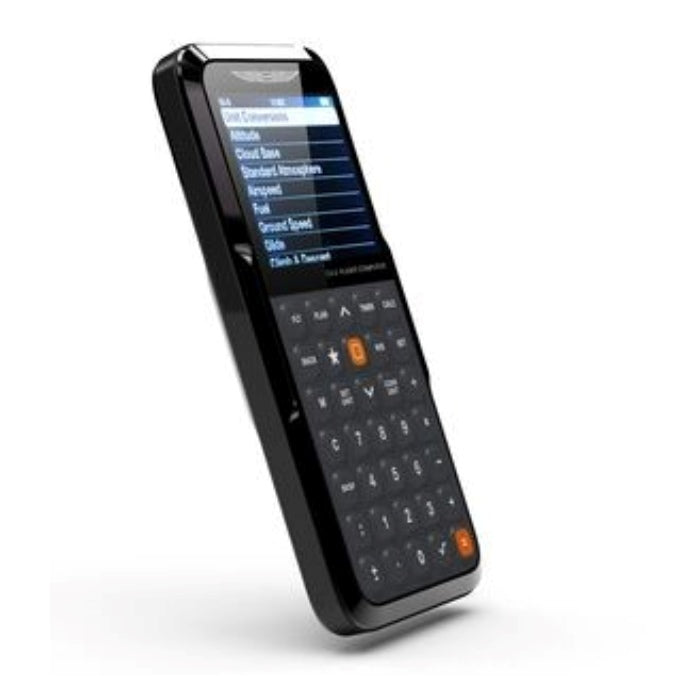
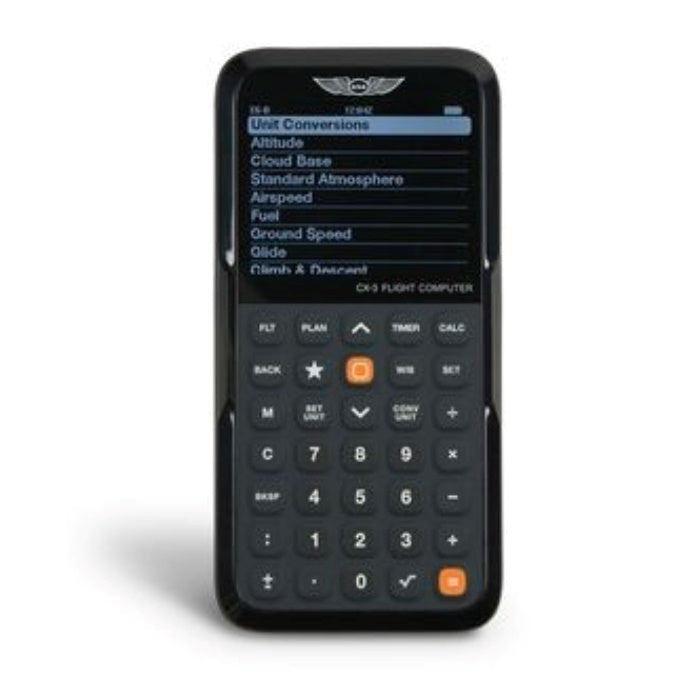
The device uses an intuitive menu structure designed to follow standard flight planning sequences so users can step through calculations with a limited number of key presses.
Functions on the unit cover navigation and performance items such as true airspeed, Mach number, fuel burn, headwind and crosswind components, center of gravity, and related parameters.
The CX-3 incorporates a color LCD screen that displays menus and separates input and output values, showing each with corresponding units of measurement.
The interface supports chained calculations in which a computed result can transfer directly as an input to subsequent functions.
The computer includes an internal clock along with stopwatch and countdown timer functions for tasks such as timing legs, fuel tank changes, or approach segments.
Twelve categories of unit conversions are built in, including distance, speed, duration, temperature, pressure, volume, rate, weight, rate of climb or descent, angle of climb or descent, torque, and angle, which together support more than 100 individual conversions.
The unit complies with FAA guidance for test aids and is approved for use on FAA and Canadian pilot, mechanic, dispatcher, and related knowledge examinations.
Ergonomic design elements include a slim housing, a simple keypad, and a removable protective cover that doubles as a base and incorporates a non-slip strip.
Backlighting and theme controls allow the user to select standard, night, or daylight views and adjust screen brightness, with illuminated keys in dusk and night modes.
Memory features retain aircraft profiles, weight and balance data, and trip planning values while power is maintained.
A micro USB port on the housing allows firmware updates and backup of stored data.
The unit weight is listed as 0.608 pounds with a separate specification of 0.70 pounds, and the body dimensions are 3-1/3 inches wide, 6-1/2 inches high, and 3/4 inch deep.
Packaging includes the CX-3 flight computer, four AAA batteries, a protective cover, and a quick start guide.